
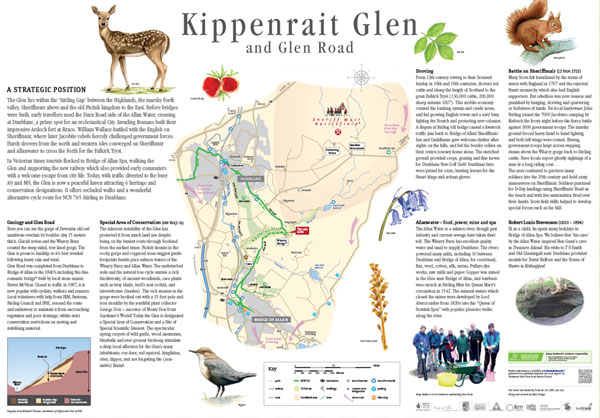
 Right on Dunblane’s doorstep, and easily accessed by either the Darn Walk or the Glen Road, is the fantastic ‘wildwood’ of Kippenrait Glen. Much of this extensive woodland, which clothes the steep sided banks of the Wharry Burn, and the more level riverbanks of the Allan Water, is thought to have been continuously wooded since the last ice age. A huge variety of beautiful woodland plants can be found – many of them rare and special. The woods look lovely at all times of the year, but in spring the bluebells and carpets of delicate white wood anemones and pungent wild garlic are certainly a highlight. Because the woodland is so special and has such varied biodiversity, it has been designated as a site of European importance and our government has a duty to conserve it.
KIPPENRAIT GLEN & GLEN ROAD INTERPRETATION PROJECT
This project emerged from the Glen Road Rescue project which highlighted that few people knew about the special conservation designations and heritage of the Glen area. We also wanted support to keep the route open as the new NCN 765 cycle link with plenty of volunteer helpers! The Interpretation Board sits by the dramatic bridge over the Wharry Burn, and links to this information via a QR code. The material comes from local experts and publications, and project funding came from Awards for All, Paths for All and Clackmannanshire and Stirling Environment Trust, via Dunblane Development Trust. We hope you enjoy all the stories and information below.
Read the Kippenrait Newsletters and Press Releases from Scottish Natural Heritage
Newsletter Summer 2015
Taking Learning Outdoors April 2015
Newsletter December 2014
Newsletter Spring 2014
Newsletter Autumn 2013
GEOLOGICAL CONTEXT
The rocks underlying Kippenrait Glen were formed more than 400 million years ago (Early Devonian period). At that time Stirling was about 20o south of the Equator on the eastern flank of what is now North America, and it was part of a volcanic province. The high relief and semi-arid climate also led to the formation of the local red sandstones. Subsequent events (in the lower Carboniferous period) led to the accumulation of pale, buff sandstones, and limestones topped by basalt lava flows on the Gargunnock Hills south of Stirling. Strong faulting along the scarp of the Ochils led to the broken relief of the Stirling gap and produced the sheets of quartz dolerite that now support Stirling Castle and the Wallace Monument.
The multiple ice ages that dominated the last two million years led to the moulding of the relief and deposition of glacial debris or ’till’, most of which is poorly-drained, boulder clay. Melting of the ice sheets was rapid from 15,000 years ago leading to the erosion of deep valleys such as Kippenrait Glen, at a time when the sea levels were much lower than today. Glacial clays were left perched on the upper flanks of the gorge (the climate deteriorated again after 12,000 but the ice failed to advance far beyond Callander). The clays became unstable under warmer and wetter climates, especially during the last 7,000 years, when sea levels rose to flood the Forth Valley (a whale’s skeleton was found at Airthrey in 1819). The slopes of Kippenrait Glen have continued to experience instability and the north-facing slope, which carries the Glen road, is particularly wet and prone to slides and flows.
Research papers on Landslides of Kippenrait Glen Michael F. Thomas Pg 65-78 Vol 32 Forth Naturalist Historian.
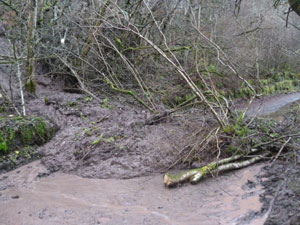 Small landslide on Glen Road |
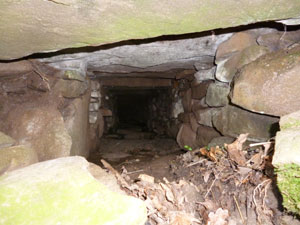 Victorian stone culvert under road – still working |
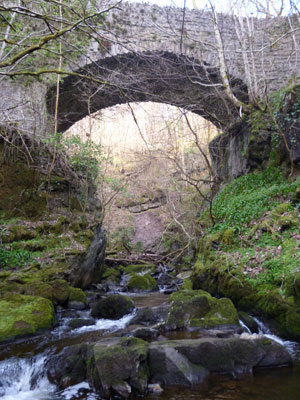 Glen Road Bridge over Wharry Burn |
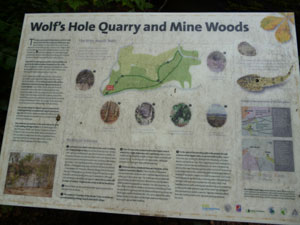 Geology at a Quarry on Glen Road in Bridge of Allan |
Local quarries (e.g. Kippenross, Kippenrait, Wolf’s Hole*, Gallow Hill) provided sandstone to build the attractive local bridges, the magnificent Dunblane Cathedral and imposing Victorian villas in Dunblane and Bridge of Allan. Further geological information in this Wolf’s Hole Quarry and Mine Woods leaflet.
CONSERVATION AND GEORGE DON
The Glen is covered by a number of conservation designations including:
- Draft Inventory of Battlefields V2 (excluding the road and above the northern bridge)
- The ‘C’ listed bridge over the Wharryburn
- Area of Great Landscape Value
- Ancient & Semi Natural Woodland
- Special Areas of Conservation (excluding the road)
- Site of Special Scientific Interest (excluding the road)
Kippenrait Glen – Site of Special Scientific Interest (SSSI) covers the wooded banks of the Allan Water between Dunblane and Bridge of Allan, including its tributaries, the Wharry Burn and the Cock’s Burn. The relatively undisturbed steep slopes support ancient mixed woodland and a large diversity of woodland plant species. The woodland canopy contains ash, birch, oak and elm with an understorey of hazel and frequent bird cherry on moist soils. The ground flora includes abundant dog’s mercury, bluebells, greater woodrush and wood anemone, sanicle, enchanter’s nightshade and ramsons. Rarer plants are bird’s nest orchid, goldilocks buttercup, moschatel and wood vetch. The woodland also supports a significant variety of insects including rare beetles and craneflies. The natural woodland cycle supports their larvae which live in bark, or decaying wood in damp areas or sandy banks by the side of streams. However, invasive species such as beech, sycamore, rhododendron, conifers, snowberry, Japanese knotweed and Hogweed are impacting on the woodland ecology. More information can be found at Nature Scot website.
George Don senior (1764 – 1814) was initially apprenticed to a clockmaker in Dunblane. He spent time recording plants found in the Glen, and became renowned for discovering bryophytes, lichens and vascular plants. He used a 15 foot pole with an iron straddle to hook plants from steep gorges and would examine them with lenses used by local cottage weavers. Volumes of Herbarium Brittanicum detailing his career findings are in the Royal Botanic Gardens in Edinburgh. A rare woodland plant Adoxa, or “Town Hall clock” since the flower looks like a clock, is found in the Glen. His son also George Don, was a plant hunter and clearly passed the genes down to Monty Don of Gardeners World! More information.
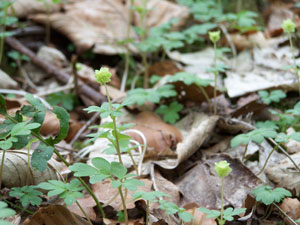 Adoxa “the town hall clock” |
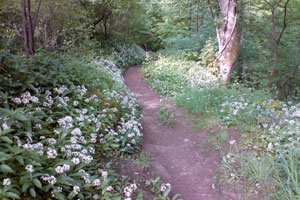 Carpets of Ramsons or wild garlic |
ROBERT LOUIS STEVENSON
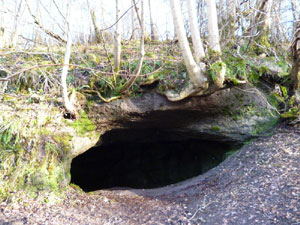
Robert Louis Stevenson (1850 – 1894) was born in Edinburgh and, being ill as a child, spent many holidays in Bridge of Allan Spa town. He greatly admired Walter Scott’s writing about the Trossachs, and was intrigued by Rob Roy not least because he thought that Stevenson was one of the names adopted following the proscription of MacGregor. ‘His cave’ (an old mine adit) is along the popular Darn walk by the Allanwater, and is thought to have inspired Ben Gunn’s cave in Treasure Island. His visits to Old Glassingall and T S Smith, who founded the Smith Institute in Stirling, provided the background story to the House of Shaws and David Balfour in Kidnapped. Initially he was encouraged by his lighthouse engineer father to study Engineering then Law, but he always wanted to be a writer, and spent time with other artists in Europe where he met his American wife. He sailed with his family on a three year voyage and settled in the Samoan islands taking the name Tusitala, meaning “Teller of Tales”. His grandfather Robert Stevenson (1772-1850) designed the new bridge at Stirling and in 1826 reported on the springs which brought such prosperity to Bridge of Allan spa town.
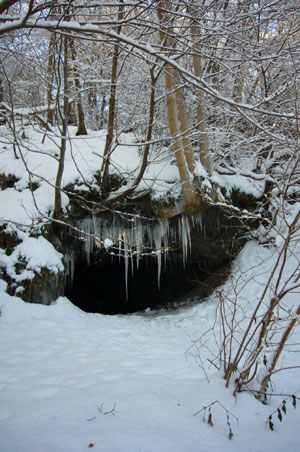 ‘Stevenson’s Cave’ by Darn Walk |
 |
William Henley – inspiration for Long John Silver
According to RLS’s letters, the idea for the character of Long John Silver was inspired by his real-life friend Henley who suffered from tuberculosis of the bone, which resulted in the amputation of his left leg below the knee. Stevenson’s stepson, Lloyd Osbourne, described Henley as “..a great, glowing, massive-shouldered fellow with a big red beard and a crutch; jovial, astoundingly clever, and with a laugh that rolled like music; he had an unimaginable fire and vitality; he swept one off one’s feet”. In a letter to Henley after the publication of Treasure Island Stevenson wrote “I will now make a confession. It was the sight of your maimed strength and masterfulness that begot Long John Silver…the idea of the maimed man, ruling and dreaded by the sound, was entirely taken from you”.
Thomas Stuart Smith (1815-1869) – inspiration for David Balfour
Thomas Stuart Smith was a man of fluctuating fortune with a colourful history who became an artist of considerable accomplishment, widely admired by his fellow artists. The family story was that Thomas’s father and uncle were in love with the same woman, had a disagreement over her and parted. Thomas was illegitimate and his mother died when he was young. His father, a merchant working in Canada and the West Indies, sent the young Thomas to school in France. When the school fees failed to arrive in 1831, Thomas deduced that his father was dead. Thomas and his uncle Alexander Smith who held the estate of Glassingall, Dunblane were shocked to hear of each other’s existence. Although AS never met his newly discovered nephew, he provided some financial support to study art in Italy, but died leaving no direct family and no will. Although he had been Thomas Stuart Smith’s main financial support, there was difficulty in proving their relationship, and eighteen people pursued claims on the Glassingall estate. It took Smith from 1849 to January 1857 to secure the inheritance of Glassingall.
The estate was much diminished through the demands of legal fees, and Smith missed the warmth and light of the continent. In 1863 he sold the estate, rented a studio in London and began to build up his own art and general collection. He liked the idea of building an Institute to house it for ‘the welfare of the town and district of Stirling in Scotland’. He provided £5000 and had a very specific idea of the accommodation, Italian style and high quality construction – three rooms to be a Museum, a Picture Gallery and a Library and Reading Room, to benefit the artisan and working classes.
Links to extra information:
A Strategic Position in Scottish History
Old Roads with Darn Road & Darn Walk, Glen Road, Glen Road Rescue Project
Kippenross history
More Droving information
Battle of Sheriffmuir